
 EN
EN


Culture Professionals Take Part in Arts and Culture Management Course Offered Through PAS
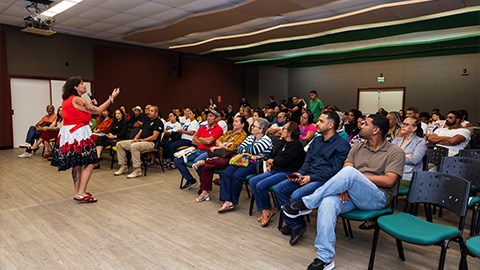
The training program is part of the "Cultura em Movimento" (Culture in Motion) public call and covers topics ranging from fundraising to the legal management of cultural projects.
Maceió, July 30, 2026 - Artists, producers, technicians, and other culture professionals have begun a training course in cultural management focused on project development, strengthening organizations, and expanding access to public policies in the sector. The initiative is one of the activities established under the Cultura em Movimento public call and is part of the culture and memory preservation component of the Plano de Ações Sociourbanísticas - PAS (Socio-Urban Action Plan.)
The course is offered completely free of charge and consists of four cohorts, with sessions running from July to September and from September to November. The opening keynote session took place on July 23 and brought together approximately 150 participants at the Sebrae auditorium in downtown Maceió. During the event, participants attended lectures, had their questions answered, and took part in discussions on topics including the identification of creative territories and the relationship between memory, identity, and development.
Among the participants is capoeira instructor and cultural producer Aldecir Cavalcanti, who works with older women. "I have great difficulty writing project proposals and securing support for our initiatives. I believe this training will help us develop future projects for our community," she said.
Culture and Development
Professors Adriana Guimarães Duarte and Josemary Omena Passos Ferrare, specialists in cultural heritage preservation, spoke to the class during the course's inaugural session. They discussed the cultural diversity that characterizes Maceió communities and its metropolitan area, highlighted opportunities in the cultural sector, and emphasized the importance of cultural projects.
Milla Pasan, a cultural producer and one of the course instructors, explained that the curriculum was designed to broaden participants' knowledge and strengthen their work in the sector. The training covers topics such as cultural management, fundraising, pricing strategies, market positioning, and participation in public grant programs.
"In addition to helping participants understand concepts related to territory and identity, the course will provide hands-on guidance on the steps involved in developing projects and prepare participants to address issues related to intellectual property and communications. I believe that everyone who embarks on this journey will be able to organize and understand their work in a much more structured way," said Milla Pasan.
About the Course
The Cultural Management Training Course consists of eight modules and a group mentoring program.
- Module 1: Territory, Identity, and Cultural Heritage
- Module 2: Creative Economy and Cultural Public Policies
- Module 3: Fundraising and Sustainability
- Module 4: Project Writing and Planning
- Module 5: Financial Reporting and Project Evaluation
- Module 6: Intellectual Property and Cultural Communications
- Module 7: Legal Formalization and Legal Management
- Module 8: Business Models and Cultural Pricing
Cultura em Movimento Public Call
Launched in November 2025, the Cultura em Movimento public call supported more than 100 projects focused on expressions of Brazilian Popular and Afro-Brazilian Culture. Selected projects received grants ranging from BRL 15,250.00 to BRL 30,800.00, depending on the application category. To learn more about the initiatives supported by the public call, visit the official website at www.editalculturaemmovimento.com.br .
PAS Initiatives
The Social-Urban Action Plan (PAS) is established under the Socio-Environmental Agreement, signed by the Federal Public Prosecutor's Office (MPF) and Braskem, with participation of the State Public Prosecutor's Office (MPE) and the Municipality of Maceió.
The PAS brings together initiatives involving the construction or renovation of daycare centers, markets, public squares, and healthcare facilities, as well as measures in the cultural, social, economic, and urban development sectors. Some of the actions are executed by Braskem; others by Maceió's local government. The program's budget of BRL 198 million, updated annually, is fully funded by Braskem.
In the cultural sector, the PAS includes the Cultural Support Program, which will support 18 groups dedicated to Afro-Brazilian and traditional cultural expressions through the end of the 2026 program cycle. This initiative also helps organize a calendar of initiatives aimed at reviving traditional festivities in the neighborhoods of Chã da Jaqueira, Chã de Bebedouro, Bom Parto, Vila Saem, and Pinheiro. An Intangible Cultural Heritage Inventory was conducted by specialists from Fundepes at the Federal University of Alagoas (UFAL) and identified cultural practitioners and traditional cultural expressions associated with the vacated areas and their surroundings.